
Genetic Testing Information
This page is designed to help breeders and owners find testing and help explain what it means
Click on the disease to learn more:
CEA - Collie Eye Anomaly
TNS - Trapped Neutrophil Syndrome
BCG - Glaucoma/Gyniodysgenisis
EOAD - Early Onset Adult Deafness
MDR1 - Multidrug Resistance/Sensitivity
PLL - Primary Lens Luxation
Imerslund Grasbeck Syndrome/Intestinal Cobalamin Malabsorption
DH/RS - Dental Hypomineralization/Raines Syndrome
SN - Sensory Neuropathy
DM - Degenerative Myelopathy
NCL - Neuronal Ceroid Lipofuscinosis
MC - Myotonia Congenita
Click on the Company Name to be directed to their website:
Where to Find Testing
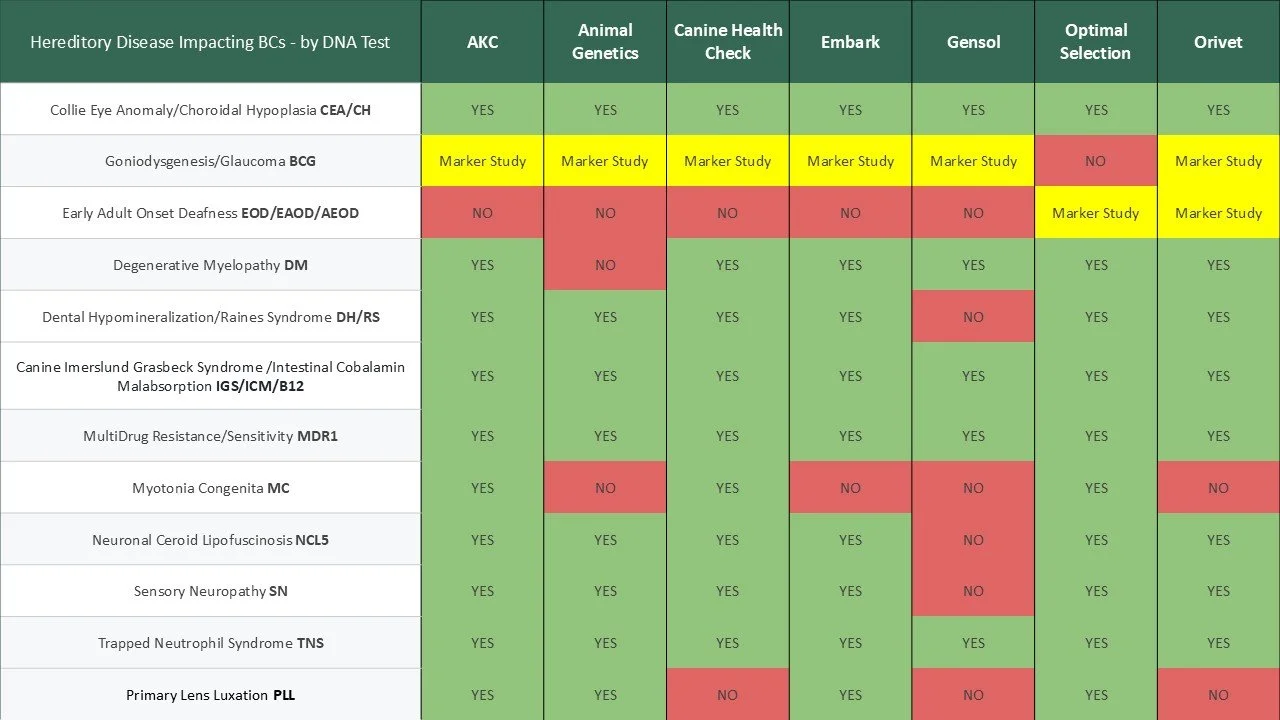
DNA testing is available through a variety of companies. As you can see in the table below, not all companies test for every disease. Sometimes a combination of testing is required. The Top Row shows the name of the company where you can order and send in your tests. See below the table for links to each company website. It is also important to note that these companies test for more conditions than that are listed below that may not be applicable to Border Collies.
DNA Terminology
Normal/Clear: 2 normal copies of the gene. The dog is free of the disease and does not carry the gene that will produce the disease
Carrier: 1 positive copy and 1 normal copy of the gene. The dog does not have the disease but can pass the gene to its progeny. A carrier should be bred only to a dog that is normal/clear
At Risk/Affected: 2 positive copies of the gene. A dog that is at risk/affected will have or develop the disease in its lifetime
Clear by Parentage: both parents have been DNA tested clear for the disease. This should be proven to puppy buyers with documentation of the DNA test results of both parents
Types of DNA Tests
Definition of “Marker”: a DNA sequence with a known location. Often referred to as a DNA landmark. They can be used to track inheritance of traits/diseases*
Direct-Marker
This is the “gold-standard” in DNA testing. The result from a direct-marker test shows the presence or absence of the specific genetic mutation that causes the disease or condition being tested. The direct-marker tests are used for diseases that have a single genetic mutation that causes the disease, called “Mendelian” diseases/traits.**
Citations:
*National Human Genome Research Institute
https://www.genome.gov/genetics-glossary/Marker
**My Dog DNA (Wisdom Panel)
https://mydogdna.com/blogs/news/direct-vs-linked-marker-tests
Linked-Marker (Marker Study)
Linked-marker or indirect marker tests, can be a stepping stone to a direct-marker test. This can also be referred to as a “Marker Study” test. Linked-Marker test markers that are physically close to the marker that is thought to cause the disease. When markers are close together, they are usually inherited together, hence “linked”. These tests are used most often when the disease marker has not been identified yet. Linked-marker tests can vary in reliability, but these tests can be necessary to further research to identify the direct genetic markers. **
Important Note: Glaucoma (BCG) and Early Onset Adult Deafness (EOAD) are linked-marker tests and the markers are not proven to solely cause the diseases. However, as stated above, they can be helpful to fully identify the exact direct-marker tests in the future